
Early phase
Positioning, safe nursing, pain-aware handling and prevention of secondary complications may be the priority. Exercise timing should follow the surgical or medical plan.
Rehabilitation
Professionally guided rehabilitation may support strength, coordination, comfort and confidence at the right stage of recovery.
Important: Do not begin exercises until your veterinary team confirms they are appropriate.
Before You Start
Confirm when rehabilitation can begin and which movements are permitted.
Use a veterinary physiotherapist or rehabilitation professional experienced with neurological cases.
Exercises should reflect pain, surgery status and neurological function.
Tip: Your vet or rehabilitation professional may also show you simple exercises you can safely continue at home to help maintain or rebuild strength. Only do exercises they have specifically approved for your dog.
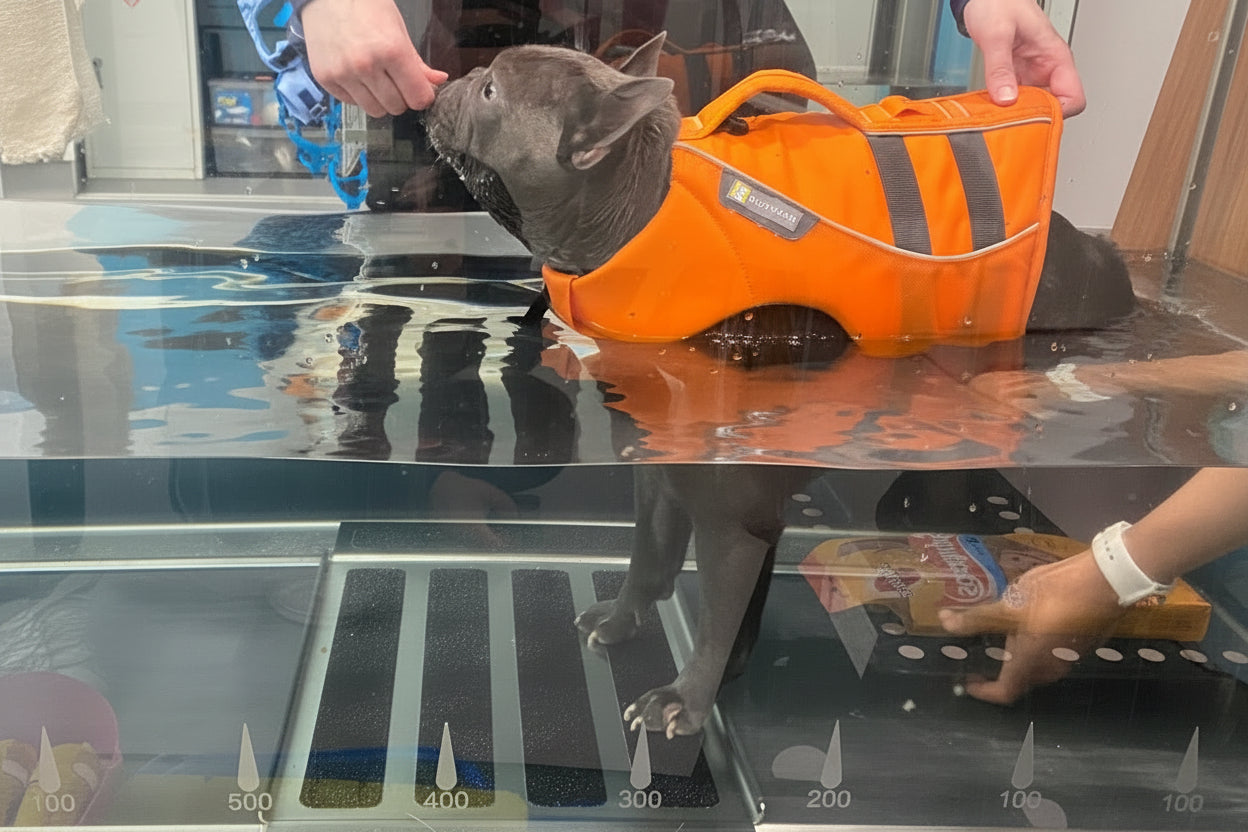
Our experience with Loui: We used Battersea in London for part of Loui’s rehabilitation. Read about Battersea’s physiotherapy service ↗. Current availability: Battersea’s own page currently says it is closed to new referrals, so check its latest status directly before making plans.
Possible Approaches
Slow supported exercises may be introduced when medically appropriate.
Targeted work may support paw placement and body awareness.
Water-based exercise may suit some dogs but is not appropriate at every stage.
Only perform exercises demonstrated specifically for your dog.
Stop and Seek Advice
Panting, shaking, crying, guarding or reluctance to move.
More weakness, dragging, knuckling or unusual fatigue.
Redness, swelling, rubbing or changes around a surgical site.
What the evidence actually says
Veterinary rehabilitation is widely used after canine spinal cord injury and IVDD. Published studies have evaluated programmes ranging from basic supported exercises to more intensive locomotor training and underwater treadmill work, but protocols, patients and outcomes vary. The ACVIM consensus therefore supports individualised rehabilitation rather than a universal exercise recipe.
Positioning, safe nursing, pain-aware handling and prevention of secondary complications may be the priority. Exercise timing should follow the surgical or medical plan.
When cleared, a professional may use supported standing, controlled stepping, balance, coordination and strengthening work matched to the neurological examination.
Underwater treadmill work can reduce weight-bearing while allowing repeated stepping, but wound status, skin, fatigue, pain and neurological function affect suitability.
Only use exercises demonstrated for your dog. More exercise is not automatically better, and fatigue or loss of technique can be a reason to stop and reassess.
See how harnesses, slings, ramps and wheelchairs may fit into a safe care plan.
Rehabilitation must be prescribed or supervised by qualified veterinary professionals.
Where physiotherapy fits
The priority may be protection, pain control and the activity restriction prescribed by the veterinary team. Do not add exercises simply because they appear in an online rehabilitation list.
Passive or assisted work may be introduced when the treating team considers it appropriate. The exact programme depends on neurological function, surgery/conservative management and the individual dog.
Later rehabilitation may focus more on controlled strength, coordination, balance and functional movement under professional guidance.
Some dogs need ongoing conditioning or adaptive support rather than a short “rehab course”. See the mobility aids guide.
Page purpose: this page explains rehabilitation options and how they fit into recovery. It does not replace the broader IVDD recovery hub or the timing-focused recovery timeline.
Trust & safety
Aubenord provides general educational guidance. Diagnosis, treatment and changes to an individual dog’s care plan should come from the veterinary professionals responsible for that dog.
Aubenord cannot assess your dog’s neurological function, pain, bladder or bowel function, diagnosis, rehabilitation needs or treatment plan.
Follow your veterinary team’s individual advice. Seek prompt veterinary assessment for new or worsening pain, weakness, wobbliness, bladder changes, paralysis or loss of walking ability.
Aubenord’s IVDD content is prepared by the Aubenord Editorial Team using peer-reviewed veterinary literature, specialist consensus guidance and reputable clinical sources.
Where owner experience, including Loui’s story, is included, it is clearly separated from veterinary evidence.
What to read next