


Caregiver Resource
How to Express Your Dog’s Bladder
A calm, practical, vet-guided guide for caregivers of dogs with mobility needs.
Start with your vet: Have your veterinary team demonstrate the method for your dog. This page is a supportive refresher—not a replacement for hands-on instruction.
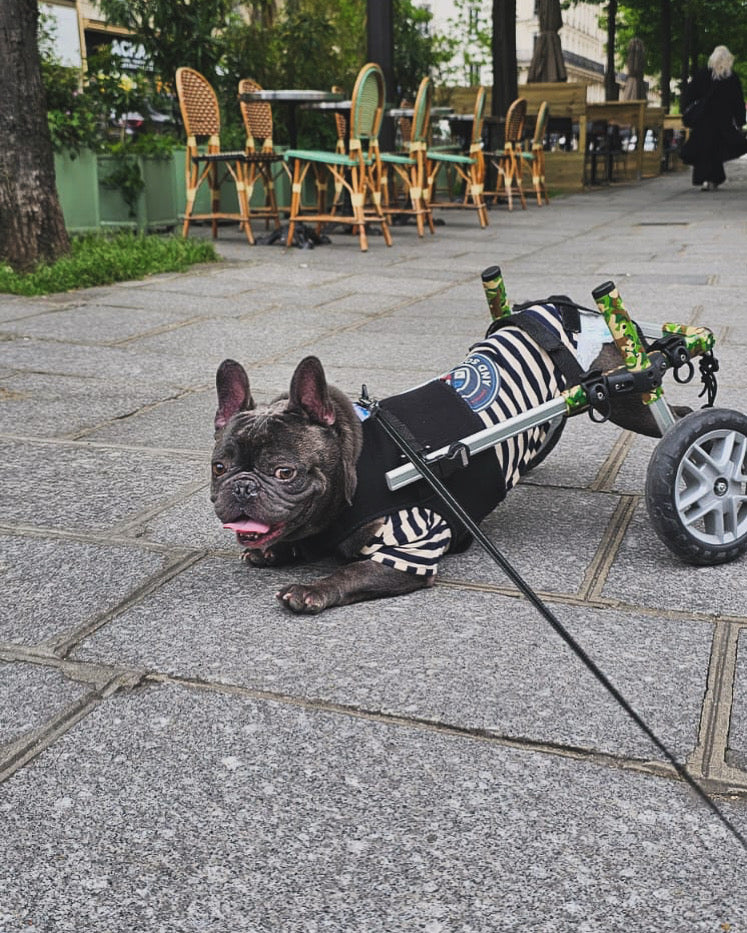
Before You Begin
Prepare with care
Set up a calm space
Choose a non-slip, easy-to-clean area. Keep towels, wipes, gloves and a record sheet nearby.
★ Helpful tip: A pee pad always comes in handy if you have one.
Follow your vet’s routine
Use the position and timing your vet recommends for your dog. Keep movements calm and give your dog time to settle.
Never force pressure
Stop if your dog appears painful or distressed, or if something feels different from their normal routine.

Option 1
Side-lying support
Some dogs are most comfortable resting on their side on a pee pad. Use only the support and handling method your veterinary team has shown you.
This picture is an orientation guide only. Your vet should show you the safe hand placement and technique for your dog.

Option 2
Supported standing
Some caregivers use a comfortable, supported standing setup. A person may support the dog from underneath; others may find a knee-level rest helpful. Choose only a position your vet or rehabilitation team has approved.
Never put weight or pressure on a recovering dog’s spine. Ask your vet to demonstrate safe support.

Option 3
Wheelchair-supported standing
A correctly fitted wheelchair or other mobility support can help some dogs stay comfortable and upright. Confirm the fit and position with your veterinary or rehabilitation team.
A cart is not right for every dog. Supervise your dog and use only equipment that fits safely.
Comfort, hydration and routine
Small routines can make a difference
Every dog’s needs are different. Your vet can help you find the routine that keeps your dog comfortable and well supported.
A small hydration reminder
If your vet says it is appropriate for your dog, adding a little water to their usual balanced meal may help some dogs take in more fluid. Keep fresh water available and ask your vet if drinking changes suddenly.
If your dog is tense
Do not continue by using more pressure. Pause, help your dog settle, and contact your vet if you cannot follow their usual routine or they appear uncomfortable.
Food and allergies
Choose a complete and balanced diet that suits your dog. If you suspect a food allergy or intolerance, ask your vet for a tailored plan rather than relying on “allergy-tested” claims.
Never withhold water or make a diet change because of bladder care without speaking to your veterinary team.
Finding the bladder
What a comfortably full bladder may feel like
Your veterinary team can show you what this feels like for your dog. When there is enough urine present, it may feel like a small water balloon in the lower rear abdomen—not the chest or rib cage.
Keep away from the rib cage
Do not work at the chest or ribs. If something feels hard, unfamiliar or wrong, pause rather than trying harder.
If you are unsure
Do not assume a soft, narrow structure is the bladder. Stop and ask your vet to demonstrate again.
Use broad, gentle, flat-hand contact—not poking fingertips or force. If you cannot confidently identify the bladder your vet showed you, do not press: stop and ask for help.
What helped us with Loui
The little routine changes that made bladder care easier
These are the practical habits that helped us manage bladder care at home. They are personal experience, not a prescription — your dog’s bladder function, skin and care schedule may be completely different.
Our routine with Loui
With Loui, we usually expressed his bladder roughly every 5–6 hours during the day and normally started on a pee pad. That was his routine, not a universal schedule. Your veterinary team should tell you how often your dog needs expressing and how they want you to monitor bladder emptying.
At night, we usually did Loui’s last bladder expression at around 11pm–midnight, then expressed him again when we woke at around 7am. Our vet told us that overnight gap was appropriate for Loui while he was sleeping. That was advice for his situation, so ask your own veterinary team what overnight timing is safe for your dog.
Rinse urine from the skin
If urine reached Loui’s belly, legs or underside, we supported his whole body, moved him into the bath after expressing, rinsed the affected skin with lukewarm water and then dried him thoroughly with a soft towel.
Keeping urine off the skin became a simple part of our routine whenever he was wet.
Dry the easy-to-miss areas
We paid particular attention between his toes, around the paws and in little skin folds so dampness was not left sitting there.
Check the skin regularly and speak to your vet if you see broken skin, worsening redness, discharge, a strong smell or irritation that is not settling.
Barrier cream: ask your vet first
For Loui, our veterinary team advised a very small amount of Sudocrem on selected irritated areas that he could not lick. We would not recommend copying this automatically.
Some human nappy creams contain ingredients such as zinc oxide that can be harmful if swallowed. Ask your vet which barrier product, if any, is appropriate for your dog and keep topical products away from areas they can lick.
Our biggest tip: get the technique and schedule from your veterinary team first, then build the home routine around what they have taught you.
Watch & Learn
Bladder-expression demonstrations we found useful
Watching different demonstrations can make the idea easier to understand, but a video cannot tell you the right hand position, pressure or schedule for your individual dog. Ask your vet or veterinary nurse to demonstrate on your dog and check your technique first.
Bladder-expression demonstration 1
A third-party demonstration we found useful while learning.
Bladder-expression demonstration 2
A second visual demonstration showing another approach.
Bladder-expression demonstration 3
Another third-party video that may help make the technique easier to visualise.
Bladder-expression demonstration 4
A further demonstration for visual reference only.
These are third-party resources and Aubenord does not control their content. For another detailed IVDD owner-care resource, see Dodgerslist’s incontinence-care tips →.
Top tips from us
You can learn this
It can feel overwhelming at first, but many caregivers find it becomes a manageable routine with patient, vet-guided practice. Some people feel confident quickly; others need several supervised sessions. You are not alone.
Returning to work
Plan care around your dog’s vet-approved routine. If flexibility is possible, have an honest conversation with your manager.
Find and train trusted help
Platforms such as Bark and Rover may help you find local sitters. Ask about relevant experience and arrange several supervised practice visits before they take over care.
Create a care backup plan
Choose a primary sitter and train at least one backup. Availability changes, and a calm Plan B helps prevent gaps in care.
If you need more practice or reassurance, contact your vet. If you need support from Aubenord, you can email us and we will do our best to help.
Optional practical support
Make handovers easier
Smart entry systems and home cameras can make it easier for a trusted, trained sitter to get in and for you to check in when needed.
Simple access
A smart lock can reduce stressful key handovers when a trained helper is coming for a scheduled visit.
Check-ins
Video check-ins can be useful for coordination, but should never replace in-person care when your dog needs it.
Use individual, revocable access codes and tell sitters clearly if cameras are operating.
Useful products
Products that can make bladder-care clean-up easier
These do not replace bladder-expression technique or veterinary advice. They are practical products we use or recommend for quicker clean-up, skin hygiene and recovery-area protection.
Disposable pee pads
Useful for catching urine, protecting the immediate care area and making a quick reset easier after bladder expression.
Washable waterproof crate protection
A low-profile waterproof layer can help protect bedding, the crate tray and the floor while keeping accident clean-up more manageable.
Skin and paw clean-up
DOUXO S3 PYO Shampoo is one of the products we keep in Loui’s care kit when antiseptic skin care is appropriate after urine reaches his lower body or paws.
If skin is persistently red, broken, painful or infected, speak to your vet rather than relying on home skin-care products.
Urgent Care
Contact your vet urgently if…
Little or no urine
Straining without producing urine, or a sudden major change in output.
Pain or illness
Distress, lethargy, vomiting, blood in the urine, or a firm or swollen-looking abdomen.
When something feels wrong
Do not keep trying with more force. Contact a vet urgently for advice.
Do not keep trying with more force. Contact a vet urgently for advice.
Important care reminder
Aubenord provides general educational information. We are not veterinary professionals, and this page is not intended to diagnose, treat or replace advice from a qualified veterinarian.
Every dog’s condition is different. Always discuss bladder care and any change in symptoms with your vet or veterinary specialist.
Trust & safety
Bladder expression must be taught on your dog
This guide is a caregiver refresher, not a first-time technique lesson. A vet or veterinary nurse should demonstrate the position, hand placement, pressure and schedule for your individual dog and check that you can do it safely.
Do not use extra force if you cannot identify the bladder, urine is not passing as expected, your dog appears painful or the routine suddenly feels different. Contact the veterinary team instead.
Editorial standards · Medical disclaimer · Bladder & bowel support
Evidence base
Sources & further reading
- Olby et al. (2022) — ACVIM consensus statement on acute canine thoracolumbar intervertebral disc extrusion
- American College of Veterinary Surgeons — Intervertebral Disc Disease
Evidence limit: bladder function and emptying need individual clinical assessment. Leakage does not prove that the bladder is empty, and an online guide cannot verify technique.